The welcome
The bagpipe and the piper's welcome: what the instrument is and why it opens the night
How the Great Highland bagpipe works, why it cannot play quietly and where the habit of a piper at the door comes from.
Reserve your evening ↗Quick answer
The Great Highland bagpipe is a reed instrument fed by a bag, with one chanter for the tune and three drones for a constant background note. Wikipedia says it cannot vary its volume or stop for rests, so players shape the music with grace notes. Bagpipes are first attested in Scotland around 1400, and the earliest references are military, which is why a piper's welcome carries ceremony. The booking page says a bagpiper welcomes guests and poses for photos.
The Great Highland bagpipe in brief
| Part or fact | Source | |
|---|---|---|
| Chanter | Plays the melody; double reed; nine notes | Wikipedia |
| Drones | Two tenor and one bass, tuned to A | Wikipedia |
| Bag | Holds the air so sound never stops | Wikipedia |
| Dynamics | None; expression comes from embellishments | Wikipedia |
| First records | Around 1400 in Scotland | Wikipedia |
How the instrument works
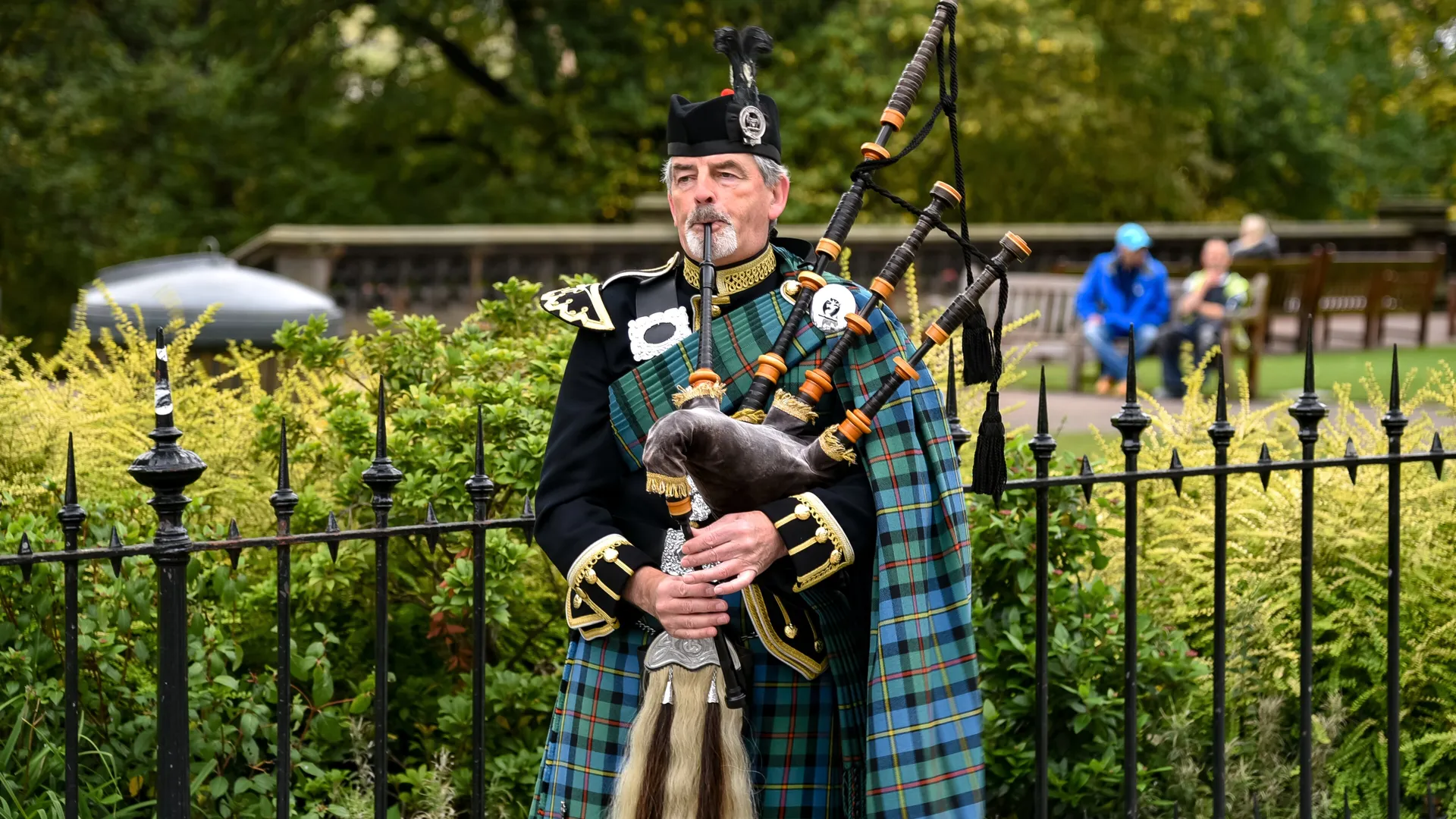
Wikipedia says a modern set of Highland pipes has a bag, a blowpipe, a chanter and three drones, two tenors and one bass. The chanter plays the melody with a double reed; each drone has a single reed. All four reeds sit inside wooden stocks, so the player cannot alter the sound with the lips or tongue. The player blows into the bag and squeezes it with the arm, and the stored air keeps the reeds sounding even while the piper takes a breath. That is why the pipes seem to play without a pause.
Why it is always loud
The airflow is continuous, so the music is legato by nature and notes cannot be separated by simply stopping the air. Wikipedia says the instrument has no dynamics and no rests. A piper therefore uses grace notes, short decorative notes called embellishments, to mark where one note ends and the next begins. It names doublings, taorluaths, throws, grips and birls as examples. The effect is a sound of great energy that cannot be turned down, which suits open air and ceremony and makes the piper a natural opening act.
The scale and the sound
The chanter spans nine notes, from one whole tone below the tonic to an octave above it, and its scale is roughly Mixolydian, with a flattened seventh, says Wikipedia. The drones are tuned to A, and today's pipers' A sits higher than the 440 Hz once standard, at around 470 to 480 Hz. A listener without any training can still hear that the tunes lean on a small set of notes and a steady hum beneath them, which gives the music its distinct, almost vocal character.
Where the pipes come from
Wikipedia places the first attestation of bagpipes in Scotland around 1400, with a text from 1396 referring to warpipes at the Battle of the North Inch. A claim that pipes were heard at Bannockburn in 1314 is debated. The first clear reference to the Highland pipes the folk-music article gives is the Battle of Pinkie Cleugh in 1547. The earliest references, then, are to the pipes in war, and the instrument became established in the British military.
Pipes in battle and on parade
Pipers played troops into battle through the 19th century, says Wikipedia. The practice was abandoned in the First World War after early losses, revived by the 51st Highland Division at El Alamein in 1943, and Bill Millin played on Sword Beach in 1944. The last combat use it notes is the Aden Emergency in 1967. That military past is why bagpipes are now a sign of ceremony, from parades to weddings, and why a piper at the door feels formal and a little thrilling.
Piobaireachd, the big music
Alongside marches and dance tunes sits piobaireachd, also called ceol mor, meaning great music. Wikipedia describes it as a solo form that begins with a slow theme, the ground, moves through increasingly complex variations and returns to the ground. It was developed by hereditary piping families, notably the MacCrimmons, and appears to have emerged in the 17th century. An evening welcome is unlikely to feature it at length, but it is the repertoire the instrument is proudest of.
What to expect from the welcome
The booking page says a bagpiper greets guests and poses for photos. It does not say where the piper stands or how long the welcome lasts. If you want a photograph, ask the piper politely and allow a moment; a kilt and a full set of pipes make a good picture. Because the instrument cannot be played softly, hold small children's hands and expect the sound to fill the room, then settle into the quieter music of the evening that follows.
Frequently asked questions
Why is the bagpipe so loud?
Wikipedia says it has no dynamics: the reeds sound at one volume, so the player cannot play softly.
How many drones does a Highland bagpipe have?
Three: two tenor drones and one bass drone, says Wikipedia.
Will there be a piper at the dinner?
The booking page says a bagpiper welcomes guests and poses for photos.
Sources