The table
Haggis, neeps and the Burns supper: the tradition behind a Scottish dinner
What haggis is made of, who held the first Burns supper and how a formal Scottish dinner is meant to run.
Reserve your evening ↗Quick answer
A Scottish folk dinner borrows from the Burns supper, a ritual meal held on or around 25 January in honour of the poet Robert Burns. Wikipedia says the first was held in Ayrshire in July 1801, and that a formal one runs from piping in the guests through the haggis, the toasts and songs to a closing Auld Lang Syne. The booking page for the Edinburgh evening promises a piper, a three-course meal, folk music and a whisky toast, but it does not call itself a Burns supper or list a menu.
The Burns supper in outline
| Typical step | Source | |
|---|---|---|
| Welcome | Piping in guests, then a host's speech | Wikipedia |
| Grace | The Selkirk Grace before the meal | Wikipedia |
| Haggis | Piped in, addressed with Burns's poem, then cut open | Wikipedia |
| Toasts | The Immortal Memory and others | Wikipedia |
| Close | A vote of thanks and Auld Lang Syne | Wikipedia |
What haggis is
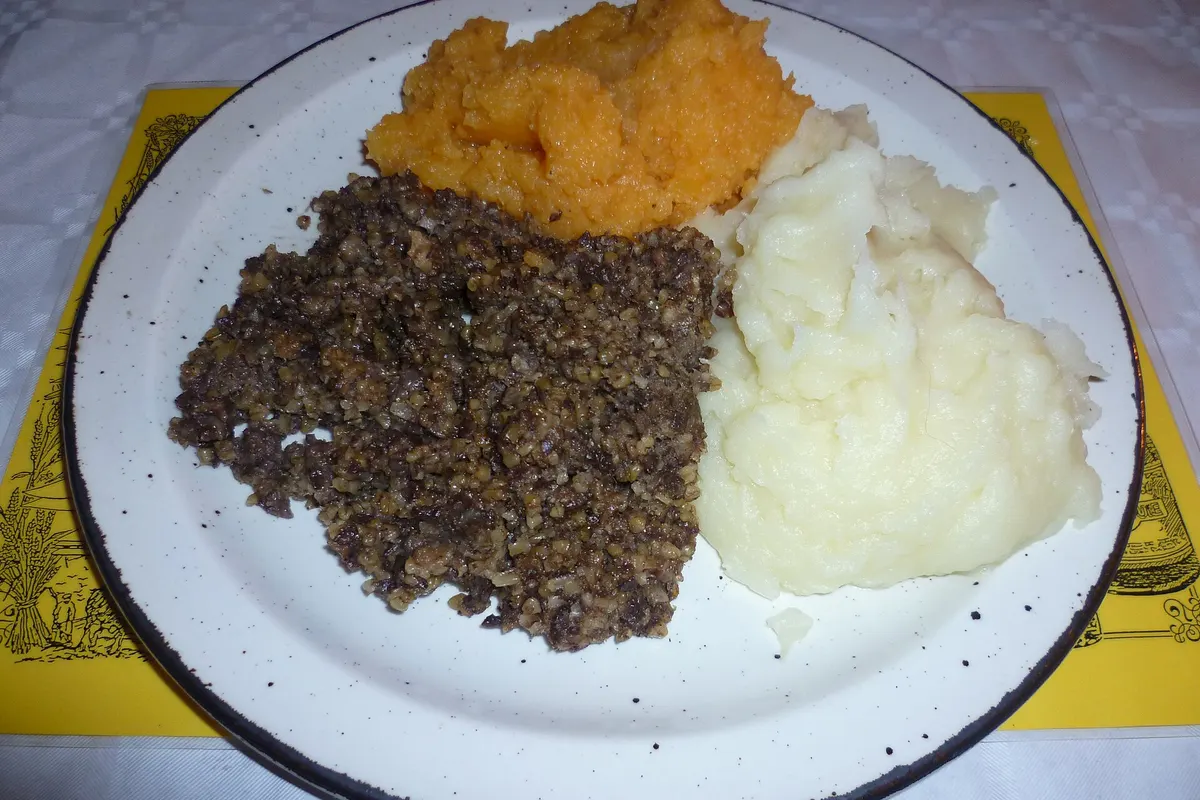
Wikipedia describes traditional haggis as sheep's pluck, meaning heart, liver and lungs, minced with chopped onion, oatmeal, suet and seasonings, mixed with stock and cooked inside the animal's stomach. Artificial casings are now common. It says the earliest written recipes for something called hagese appear in a verse cookbook from around 1430 in Lancashire, so the dish is older than its national reputation. Vegetarian haggis went on sale in 1984 and now takes a large share of sales, according to the same article, which makes it easy to ask for if you avoid meat.
Why a poet made it national
Robert Burns's poem Address to a Haggis dates from 1786 and, says Wikipedia, helped to make haggis the national dish. The poem treats the pudding as a hero, with a ceremony of its own at a supper: the haggis is carried in, the poem is recited and the pudding is cut open at the closing lines. That small piece of theatre is why a bagpiper often leads the haggis to the table, and why the dish is rarely served without a story.
Neeps and tatties
Haggis is traditionally served with neeps and tatties, which Wikipedia explains as swede turnip and potato, boiled and mashed separately, and with a dram of Scotch whisky at a Burns supper. For a visitor the pairing is a gentle introduction: the earthy, peppery pudding is softened by sweet root vegetables. Whether your dinner on Chambers Street includes any of this is for the provider to say, because the booking page publishes no menu.
Who was Burns
Wikipedia gives Burns's birth as 25 January 1759 at Alloway in Ayrshire and his death as 21 July 1796 in Dumfries, at 37. He is widely regarded as Scotland's national poet. His first book, Poems, Chiefly in the Scottish Dialect, appeared in Kilmarnock on 31 July 1786, and an Edinburgh edition followed in April 1787. He also gathered and wrote songs for James Johnson's Scots Musical Museum, where he is credited with roughly a third of the six hundred songs. That song-collecting is the link between Burns and a folk evening.
How the supper began
According to Wikipedia, friends of the poet held the first supper in his memory at Burns Cottage on 21 July 1801, the fifth anniversary of his death. A Greenock Burns club held its first supper in January 1802, believing 29 January to be his birthday, and in 1803 found parish records that gave 25 January 1759. Suppers have been held around that date since. The date is why Burns Night in late January is a fixture across Scotland, and why a dinner at any time of year can still echo the ritual.
The order of a formal supper
Wikipedia outlines the usual running order: guests are piped in, the host welcomes them, the Selkirk Grace is said, soup is served, the haggis is piped in and addressed, the main course follows, and then come the toasts. The Immortal Memory is the main speech to Burns, followed by an Address to the Lassies and a Reply to the Laddies. Songs and poems by Burns fill the evening, and a vote of thanks leads into everyone singing Auld Lang Syne. A tourist dinner usually keeps the piper, the food, the music and the toast, and drops the speeches.
Auld Lang Syne
Burns sent the song to the Scots Musical Museum in 1788, says Wikipedia, and described it as an old song that he took down from an old man. An earlier ballad by James Watson, printed in 1711, shares its first verse and chorus. The tune now used was first paired with the words in 1799. It is sung at midnight on Hogmanay and, in Scotland, with arms crossed only for the last verse. If your evening ends with it, you will be taking part in one of the world's best-known folk songs.
Frequently asked questions
Is the Edinburgh dinner a Burns supper?
The booking page does not call it one. It describes a piper's welcome, a three-course meal, folk music and a whisky toast.
Is vegetarian haggis a thing?
Yes. Wikipedia says vegetarian versions have been sold commercially since 1984.
When is Burns Night?
25 January, the date parish records give for Burns's birth in 1759.
Sources